
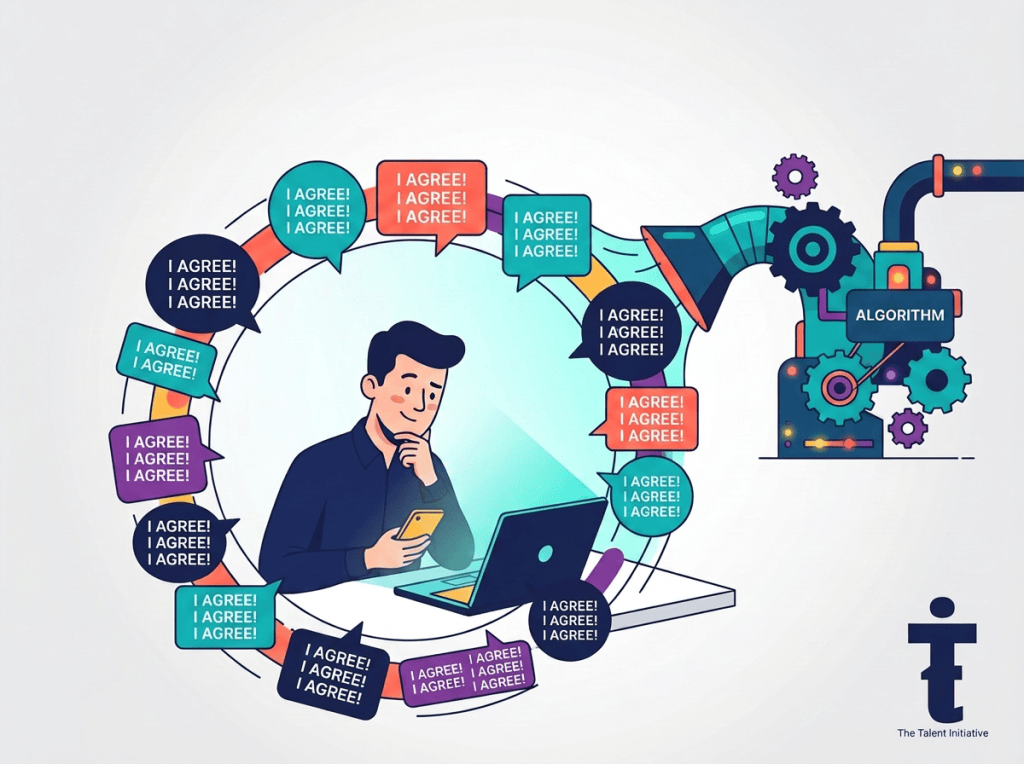
The last few weeks I’ve noticed something interesting: my LinkedIn engagement has jumped. More impressions, more comments, more people popping up in my notifications.
It’s flattering. It’s also a good reminder that what we see online isn’t a neutral reflection of reality. It’s a curated, personalised feed designed to keep us looking.
And that matters, because the thing that gets amplified most often isn’t the thing that’s most accurate. It’s the thing that’s most engaging.
Your feed isn’t “the world”
Most platforms don’t show you “what’s happening.” They show you what they think will keep you scrolling.
That means your feed becomes a mirror of:
- What you’ve clicked
- What you’ve watched for more than a few seconds
- What you’ve argued with
- What you’ve shared
- What your friends are reacting to
Over time, that mirror turns into a room. Then a hallway. Then an echo chamber.
You don’t even have to be extreme for it to happen. You just have to be human.
Popular isn’t the same as true
“Popular” content usually has a few things in common:
- It’s simple
- It’s emotional
- It’s confident
- It has a villain
- It has a hero
- It offers certainty
Truth is often the opposite:
- It’s messy
- It’s conditional
- It changes when new information appears
- It requires context
The internet doesn’t reward context. It rewards confidence.
And when you’re young, or just tired, confidence can feel like truth.
Young people are growing up inside the echo
I worry about how easily younger people can be influenced by what they see repeatedly on TikTok, Snapchat, YouTube Shorts, Instagram Reels. Pick your poison.
If you’re 15 or 19 and your feed keeps showing you the same message in different packaging, it starts to feel like:
- “Everyone thinks this.”
- “This is just how it is.”
- “If I don’t agree, I’m the weird one.”
But repetition isn’t evidence. It’s just repetition.
And the scariest part is that the algorithm doesn’t care whether the message is healthy, accurate, or good for you. It cares whether you stay.
Echo chamber example #1: AI hype (and the stress it creates)
AI is real. It’s useful. It’s also being sold like a miracle cure.
If you spend enough time online, you’ll see a steady drip of:
- “AI will replace you.”
- “If you’re not using AI, you’re falling behind.”
- “This one tool will 10x your productivity.”
- “Everyone is shipping agents.”
Some of it is true. A lot of it is marketing. And some of it is just people performing certainty because certainty gets clicks.
The result? People get stressed.
I see it in candidates and clients:
- People feeling like they need to reinvent themselves overnight
- Leaders feeling pressure to “do something with AI” without a clear problem to solve
- Teams adopting tools without governance, then panicking about risk later
AI should be treated like any other capability: useful when applied to a real problem, dangerous when adopted as a religion.
What’s popular right now is the story that AI is inevitable and immediate.
What’s true is more nuanced:
- Some roles will change fast
- Some will change slowly
- Some will get better
- Some will get worse
- Most people will adapt, like they always have
Echo chamber example #2: the manosphere (and what it teaches boys)
The other echo chamber I can’t ignore is the manosphere. The Andrew Tate-style content that tells young boys they’re disenfranchised, that women are there for them, that relationships are a power game, and that empathy is weakness.
It’s seductive because it offers:
- A simple explanation for complex feelings
- A villain (women, “society”, “wokeness”)
- A hero (the alpha)
- A playbook (dominate, win, take)
And it spreads because outrage spreads.
If a young guy watches a couple of clips out of curiosity, the algorithm doesn’t say, “Let’s balance that with healthy relationship models and emotional literacy.”
It says, “Great, you watched. Here’s more.”
That’s how a feed becomes a worldview.
And it’s not just a “kids these days” issue. Adults get pulled into this stuff too. But younger people are forming their identity while the machine is shaping the inputs.
The cost of living in a distorted reality
When your feed becomes your reality, a few things happen:
- You start to overestimate how common extreme views are
- You start to underestimate how many decent, reasonable people exist
- You start to think the loudest voices represent the majority
- You start to feel more anxious, angry, or hopeless
And then you carry that into real life:
- Into relationships
- Into work
- Into how you treat people
- Into how you see yourself
A practical way to stay sane (and grounded)
Here are a few simple habits I’m trying to stick to:
- Treat your feed like a barometer, not a map. It can tell you what’s getting attention, not what’s true.
- Ask “Who benefits if I believe this?” If the answer is “someone selling me something,” slow down.
- Follow people who disagree with you (and aren’t idiots). Not hate-following. Just broadening.
- Notice how content makes you feel. If it reliably makes you angry or inferior, it’s doing its job for the platform, not for you.
- Talk to real humans. Offline conversations are still the best antidote to online certainty.
Bringing it back to LinkedIn
LinkedIn is a more professional platform, but it’s still driven by the same mechanics: attention.
So if your impressions jump (like mine have), enjoy it, but don’t confuse it with a perfect signal of value or truth.
Sometimes the algorithm is rewarding:
- consistency
- clarity
- a strong point of view
And sometimes it’s rewarding:
- controversy
- certainty
- outrage
The trick is to build a voice that earns trust, not just reach.
Because in the long run, trust beats virality.
Final thought
If you take one thing from this: popular is not the same as true.
And if you’re raising kids, mentoring younger people, or leading teams, it’s worth naming that out loud.
The algorithm is not a teacher. It’s a mirror with a business model.
 The Talent Initiative
Leave a comment