
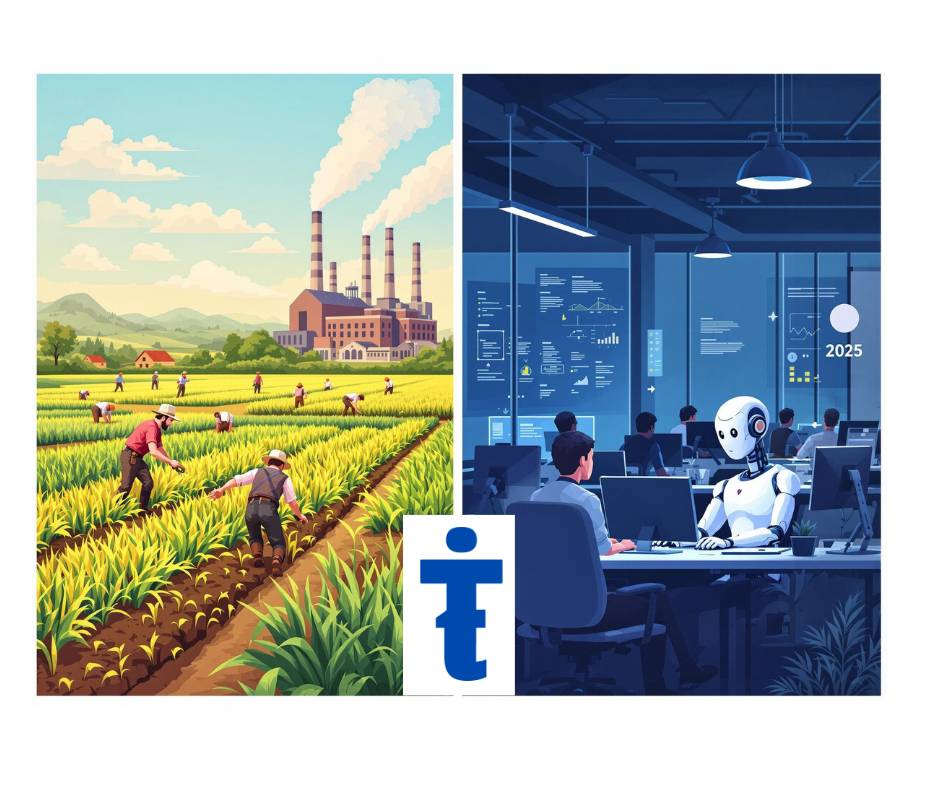
Let’s take a quick trip back in time. During the Industrial Revolution, steam engines, mechanised looms, and assembly lines swept through industries, completely transforming how people worked. For many, this was terrifying, decades-old trades and crafts were suddenly at risk, and the idea of machines “taking jobs” was as real then as it feels with AI today.
The Industrial Revolution: Disruption, Fear, and Adaptation
Back then, the fear was palpable. Workers worried about being replaced by machines, and in many cases, they were right to be concerned. But here’s what history shows us: while some jobs disappeared, many more were created. Entirely new industries sprang up. Think railways, manufacturing, logistics, and eventually, the rise of white-collar work. The workforce adapted, new skills became valuable, and society moved forward, often in ways people couldn’t have imagined at the time.
2025: The AI Revolution: Déjà Vu with a Digital Twist
Fast forward to 2025, and we’re standing at a similar crossroads. Only this time, it’s not steam engines, but artificial intelligence and automation reshaping the landscape. The headlines are familiar: “AI will take your job!” “The rise of the machines!” It’s easy to feel the fear. (and let’s face it, those of us old enough to have grown up with the Terminator movie franchise. Skynet is scary!)
But just like the Industrial Revolution, the reality is more nuanced. Yes, some roles, especially repetitive or data-heavy ones are being automated. But at the same time, entirely new opportunities are emerging. AI is creating demand for roles in data science, machine learning, AI ethics, prompt engineering, and human-AI collaboration. Plus, there’s a growing premium on the very skills that machines still struggle with: empathy, creativity, critical thinking, and relationship-building.
The Human Element: What’s Different This Time?
One key difference? The speed. The Industrial Revolution unfolded over decades; AI is moving at a breakneck pace. That can make the fear feel sharper and the adjustment period shorter. But the core truth remains: adaptability is everything.
The most successful businesses and professionals will be those who embrace change, invest in new skills, and focus on what makes us uniquely human. The future belongs to those who can blend technical savvy with emotional intelligence, people who see AI not as a threat, but as a tool to amplify their impact.
Final Thoughts
Every revolution in work has brought fear, but also opportunity. The Industrial Revolution didn’t end work, it changed it. The AI revolution will do the same. Our job is to stay curious, keep learning, and focus on the value only people can bring.
 The Talent Initiative
Leave a comment